Weekdays 8:00am-5:00pm Sat Closed Sun Closed

Why is my Volkswagen AC not blowing cold air? You might be low on refrigerant, or the compressor could be failing. Sometimes, it’s something as simple as a dirty cabin filter or a blown fuse.
Before paying for repairs, check whether the fan works and how much air comes through the vents. These small details can help your mechanic find the problem faster.
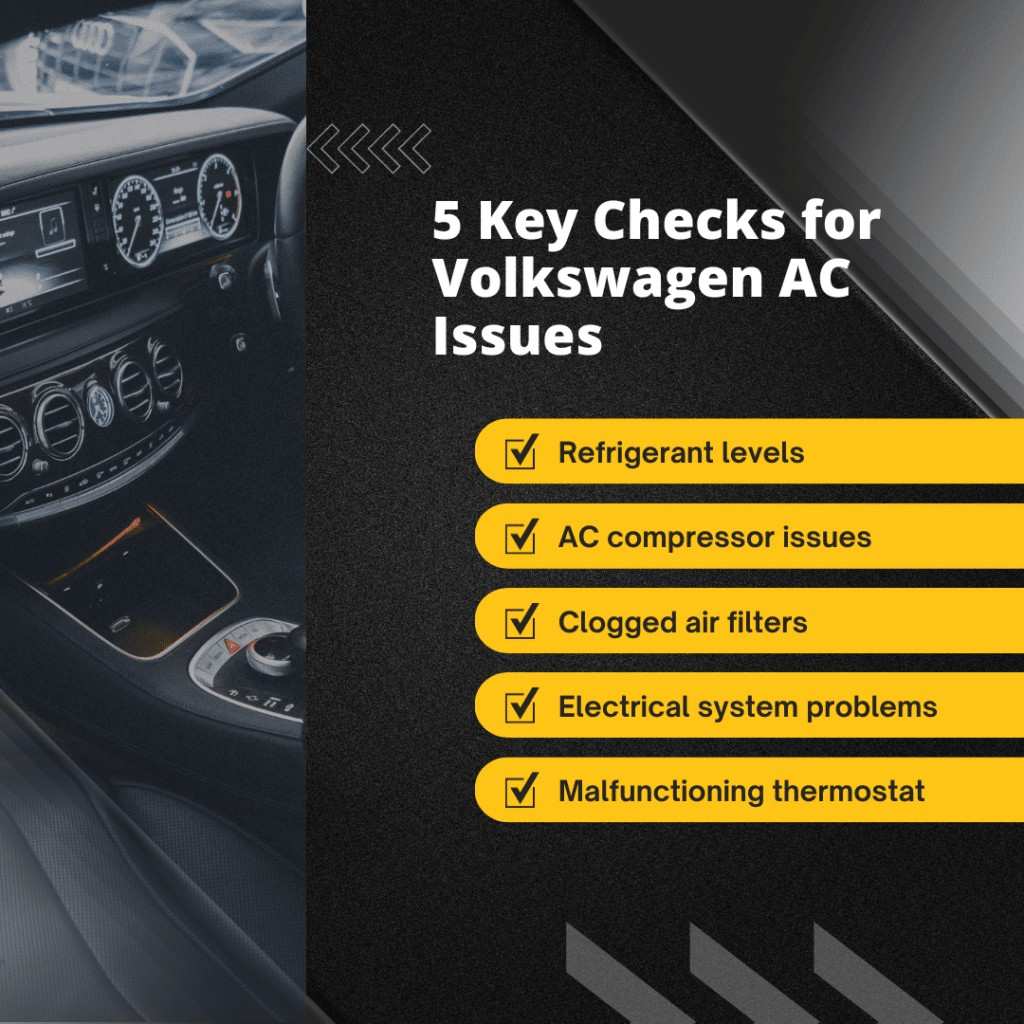
There are several reasons "why is my Volkswagen AC not blowing cold air" might not be cooling as expected. Here are five key areas to check:
Refrigerant levels
Low refrigerant is one reason your Volkswagen AC might stop blowing cold air. This often happens when there’s a leak somewhere in the system. Even if you add more refrigerant, the problem will come back unless the leak gets fixed.
Your AC compressor helps keep the cold air flowing. If it’s starting to fail, the air coming from your vents might not feel as cool as before. You may also hear strange noises when you turn on the AC.
When was the last time you changed your cabin air filter? A dirty filter can block airflow and leave your vents blowing weakly.
Sometimes, the problem isn’t mechanical at all. A blown fuse, bad wiring, or a faulty fan control can keep your AC from working.
A faulty temperature sensor or blend door can cause warm air to enter the cabin. Your AC may run, but the vents won’t feel cold.
If your Volkswagen AC stops working, start with the simple checks. Look at the fuses, listen for unusual sounds, and see whether the cooling fans run.
Repair costs depend on what’s wrong and which Volkswagen you drive. Here are some average U.S. estimates from RepairPal.
| Volkswagen AC Repair | Estimated Cost |
| Jetta cabin air filter | 75–107 |
| Jetta AC recharge | 257–338 |
| Jetta AC condenser | 827–1,068 |
| Jetta AC compressor | 981–1,461 |
| Tiguan AC compressor | 943–1,524 |
These estimates include typical parts and labor costs. Your final bill may differ based on the model, damage, and extra work needed.
Yes, and it’s more common than you might think. Just because the compressor pulley turns doesn’t mean the system is cooling properly.
Low refrigerant can cause this problem. A blocked expansion valve or faulty pressure sensor can also stop cold air from reaching the vents.
Some newer Volkswagens don’t use a standard compressor clutch. A mechanic can check whether the compressor is working as it should.
Refrigerant issues
Even if the compressor is running, if there's a problem with the refrigerant, such as low levels or leaks, it won't cool effectively. The compressor needs an adequate amount of refrigerant to cool the air.
Compressor clutch failure
The compressor clutch plays a key role in activating and deactivating the compressor, allowing it to function effectively. If it's malfunctioning, the compressor may be unable to maintain the correct pressure, leading to insufficient cooling.
Blocked components
Parts like the condenser or the expansion valve can become blocked or malfunction. Even with the compressor running, these blockages can prevent the system from cooling effectively.
Faulty sensors or controls
Sometimes, sensors or control systems within the AC unit can fail, leading to incorrect signals being sent to the compressor. This can affect the cooling efficiency, even if the compressor itself is in good working order.
Your Volkswagen’s AC works hard during a Texas summer. A little upkeep can help keep it running well.
You shouldn’t need to top up refrigerant regularly. If the system keeps losing its charge, there’s likely a leak somewhere.

Start by setting the temperature to its lowest setting. Turn the AC on and test each fan speed.
If plenty of air comes out but it’s warm, the cooling system needs checking. Weak airflow may point to the cabin filter or blower fan.
Other signs worth checking include:
Cooling that comes and goes: The cooling fans, sensors, or refrigerant level may be causing trouble.
Strange noises: A worn belt or failing compressor could be making the sound.
Musty smells: Check for a dirty cabin filter or moisture buildup.
Think your Volkswagen might be leaking refrigerant? Here’s what to check before taking it to a shop.
The Environmental Protection Agency advises proper refrigerant handling during vehicle AC service. Leave pressure testing and refrigerant work to a trained technician.
Volkswagen fuse locations aren’t the same across every model. Even two cars from different model years may have different layouts.
Here are a few common places to check:
Some older Volkswagens have AC-related relays near the dash. Newer ones may use control modules instead.
Always check the fuse chart for your exact model and year. Never replace a blown fuse with one rated for higher amperage.
A Volkswagen AC repair might cost a few hundred dollars or well over $1,000. It depends on which part needs work.
RepairPal puts a Jetta AC recharge at around 257–338. Replacing the condenser costs roughly 827–1,068.
A leak or damaged part can push the total higher.
A Jetta AC compressor replacement typically runs between $981 and $1,461, according to RepairPal. For a Tiguan, the estimate is 943–1,524.
Ask your mechanic what the price covers. Some jobs need extra seals, refrigerant, or system cleaning.
Most Volkswagens have fuse panels inside the cabin and under the hood. The exact AC fuse depends on your model and year.
For example, some Golf Mk7 models use cabin fuse SC7 for climate controls. Check your owner’s manual before removing anything.
One clue is air that no longer feels as cold as it used to. You might also notice the cooling getting worse on hot afternoons.
A mechanic can test the system to see whether it’s low on refrigerant. If it is, have them check for leaks first.
If your AC cools while moving but gets warm at stoplights, check the condenser fan. Driving pushes air through the condenser, which helps cool the refrigerant.
A weak fan can make cooling worse when you’re parked. Low refrigerant or other AC faults can cause similar symptoms.
Usually, no. Clear water dripping beneath your car after running the AC is often normal condensation.
A refrigerant leak is harder to spot because the fluid can escape as gas. If your AC isn’t cooling, have a technician check it rather than guessing.
Your Volkswagen’s AC shouldn’t leave you sweating through every drive. Whether it’s a worn compressor, a leak, or a faulty fuse, finding the cause early can help prevent bigger repairs. Need your Volkswagen AC checked? Contact Europe Services in Killeen, TX, to book an inspection or request a repair quote.