Weekdays 8:00am-5:00pm Sat Closed Sun Closed
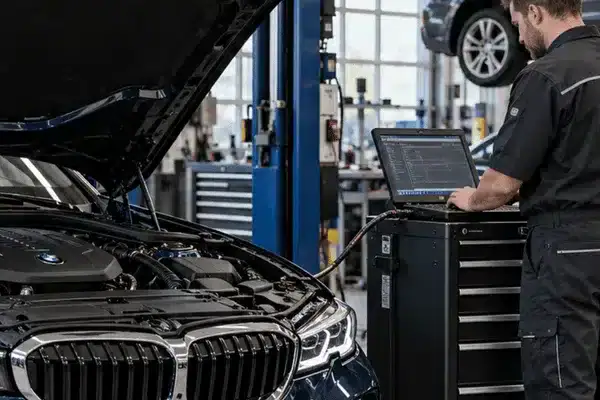
BMW ECU tuning changes the software that controls your engine. A Stage 1 flash can give turbocharged BMWs more power without replacing major engine parts. But there’s a trade-off. The extra load can increase wear, and certain warranty claims may be denied if the tune causes damage.
BMW has strict rules when it comes to engine tuning. Its 2026 warranty booklet specifically prohibits aftermarket performance tuning kits, and dealership diagnostic tools can automatically detect signs that a car has been tuned. So, before making changes to your turbocharged BMW, it's worth understanding what tuning actually does, how it could affect your warranty, and what to ask the tuner before going ahead.
At Europe Services in Killeen, Texas, our ASE-trained technicians handle BMW diagnostics, servicing, and ECU remapping.
Modern petrol-powered BMWs have an engine computer called the Digital Motor Electronics (DME). It controls fuel, ignition timing, and turbo boost. BMW programs it to balance power, fuel use, emissions, and engine life.
ECU tuning changes those factory settings. The goal is usually more torque, quicker response, or higher horsepower. Those settings aren’t only about performance. The EPA lists fueling strategy and ignition timing among the design elements manufacturers use to control emissions, which is why engine software sits at the center of the warranty and legal questions covered below.
You’ll often hear tuners mention three stages:
| Stage | Typical Setup |
| Stage 1 | Software changes using stock engine hardware |
| Stage 2 | Software matched to supporting parts |
| Stage 3 | Larger upgrades, often including a bigger turbo |
These aren’t official BMW categories. What counts as Stage 2 or Stage 3 depends on the tuner. Even a single Stage 1 map is often sold in versions for different fuels, such as 91 octane, 93 octane, or an ethanol blend, and each version produces different results.

A BMW Stage 1 tune changes how the engine responds when you accelerate. You may feel the difference most when passing another car or climbing a hill.
Several settings work together to make that happen:
Stage 1 usually keeps the original engine hardware. That doesn’t mean the engine works under the same conditions as before.
Some BMWs accept software through the OBD-II diagnostic port. Others need additional work before the tune can be installed.
Either way, the car’s electrical supply has to stay stable while new software is written. BMW’s own service bulletins instruct technicians to connect an approved battery charger or power supply whenever control modules are programmed.
That depends on which BMW you drive.
Turbo engines such as the N54, N55, and B58 have more room for power gains than most non-turbo engines. The N54 uses two turbochargers. The N55 that replaced it switched to a single twin-scroll turbo, and the B58 has carried BMW’s turbocharged inline-six forward since 2015.
A B58-powered M240i, for example, can show a noticeable increase in midrange torque. That’s the pull you feel when accelerating onto a highway. From the factory, the U.S.-market M240i produces 382 horsepower and 369 lb-ft of torque, with peak torque available from 1,800 to 5,000 rpm, according to BMW.
Some Stage 1 software packages advertise horsepower gains of 20% or more. Actual results depend on the engine, fuel, and tune. For example, bootmod3, a flash-tuning platform for B58-powered BMWs, advertises Stage 1 gains of up to 18% horsepower and 26% torque on 91-octane fuel, and up to 20% horsepower on 93 octane. Note that the advertised torque gain is larger than the horsepower gain. BMW of North America has observed that aftermarket tuners commonly claim power and torque increases of up to 40% over stock.
Don’t judge a tune by its advertised peak horsepower alone. Ask for before-and-after dyno results from a similar car.
Also, check which fuel the software needs. A map built for 93-octane gas shouldn’t be run on 87-octane fuel.
Owners of newer BMWs may find that a simple software flash isn’t an option.
Since around mid-2020, many BMW engine computers have used stronger software locks. These prevent tuners from changing certain factory settings through the usual diagnostic port.
Tuning suppliers generally identify these as Bosch DMEs with a production date of June 2020 or later, used with engines including the B48, B58, and S58. The DME’s production date isn’t always the same as the car’s build date, so the control unit itself has to be checked.
The contrast with earlier cars is sharp. When bootmod3 launched support for the B58, it reported that the first flash, including the DME unlock, took about three minutes through the diagnostic port.
Some DMEs need a bench unlock, where a specialist accesses the control unit directly.
In 2026, more unlock options have become available for certain BMW models. Still, not every engine computer supports the same process.
Unlocking adds cost and may mean leaving your car at the shop longer. Ask about compatibility before paying for tuning software.
Many older DMEs allow software flashing through the diagnostic port.
Many B48, B58 and S58 DMEs have added security that restricts OBD flashing.
Some DMEs require a bench unlock, adding time and cost.
Here’s where BMW owners need to be careful.
Tuning doesn’t automatically cancel every warranty claim. But BMW takes a firm position on engine software changes.
BMW’s 2026 New Vehicle Limited Warranty provides basic coverage for four years or 50,000 miles. It also expressly prohibits aftermarket engine performance tuning. The booklet states that modifications that alter the car’s original engineering void coverage on the affected original drivetrain and emission control components when the modification is responsible for the failure. It also names changes to the engine control module, transmission control module, intake filter, and downpipes, among the modifications it prohibits.
BMW warns that increased boost and engine loads can damage the turbo, engine, and other drivetrain parts.
The Federal Trade Commission explains that aftermarket parts alone don’t cancel an entire warranty. However, manufacturers can deny coverage when a modification causes the failure.
Here’s what that means in practice:
| Repair | Warranty Concern |
| Faulty window motor unrelated to tuning | Generally lower risk |
| Turbo failure linked to increased boost | Higher risk of denial |
| Engine damage caused by tuning | Higher risk of denial |
| Unrelated infotainment fault | Generally lower risk |
BMW can also spot signs of past tuning. Its service bulletin SIB 00 04 21 explains how dealer diagnostic software flags suspected engine changes.
Putting the factory software back doesn’t guarantee those signs will disappear.

Not every Stage 1 tune is street-legal.
The U.S. Environmental Protection Agency prohibits changes that defeat required emissions controls. That includes certain software changes, even when the original exhaust parts stay installed.
The EPA’s tampering enforcement policy addresses engine tuners directly, stating that products that change an engine computer may be illegal defeat devices and that installing them may be illegal tampering. It singles out tuners that reprogram the engine while overriding the on-board diagnostic system, so no check engine light appears, as an egregious example.
Two details from that policy are easy to miss. The rules apply for the entire life of the vehicle, whether or not the warranty has ended. And changes that affect the on-board diagnostic system can be enforced regardless of their effect on emissions.
Keeping your catalytic converter doesn’t automatically make a tune legal.
Before buying, ask whether the software has proof of emissions compliance for your exact BMW model. One form of proof the EPA recognizes is an exemption from the California Air Resources Board (CARB), issued as an Executive Order that covers specific parts or software on specific vehicles.
Avoid maps that shut off emissions sensors or hide fault codes. You could face problems with emissions compliance, inspections, or future repairs.
Typing “ecu tuning near me” into Google gives you plenty of choices. Finding someone who understands your BMW’s engine is another matter.
Before booking, ask a few questions:
At Europe Services, we work on BMW engines, electrical systems, and performance upgrades. Our team can assess your car’s condition and discuss suitable options.
Our BMW servicing guide also explains what to expect from an independent BMW repair shop.
No, tuning doesn’t automatically cancel every warranty claim. Repairs unrelated to the modification may still qualify for coverage. BMW can deny claims when tuning causes damage, so read your warranty terms before making changes.
Yes, BMW dealers have tools that can detect signs of engine tuning. BMW’s ISTA diagnostic software can flag suspected changes to the DME. Flashing the car back to stock doesn’t guarantee those signs will disappear.
Not necessarily, but you shouldn’t assume there’s no risk. The engine has to handle more boost and heat, particularly when you accelerate hard. It’s worth having the plugs, coils, and cooling system checked first, even if the car seems to run fine.
Two BMWs with the same engine won’t always show identical gains. The fuel you use, the tune itself, and the engine’s condition all play a part. Ask to see dyno results from a car with a similar setup so you have a better idea of what to expect.
If you’ve been wanting more pull from your BMW, Stage 1 might be worth considering once the warranty ends. Just bear in mind that a turbo or engine repair can be expensive, especially if you’ve increased the load on those parts. Work out what you’re comfortable spending and whether the extra power matters enough to you.
You don’t always need new software just because you’ve fitted an intercooler or charge pipe. Some of these parts work fine with a Stage 1 map. If you’re considering a larger turbo or changes to the fuel system, talk to your tuner before ordering anything.
Check what your tune calls for before filling the tank. Some maps are written for 91- or 93-octane gas, and using a lower grade can cause knock when the engine is working hard. If your usual gas station doesn’t carry the right fuel, ask about a map designed for the grade you can buy locally.
A Stage 1 tune can bring out more of your BMW’s power, but it’s worth checking a few things before making changes. Have the engine checked, read the warranty terms, and make sure the software meets emissions rules. Interested in BMW performance upgrades? Call Europe Services in Killeen to arrange an inspection or get a tuning quote.