Weekdays 8:00am-5:00pm Sat Closed Sun Closed

San Antonio heat can be tough on any vehicle, and Land Rover engines are no exception. During the hottest months, the city’s average highs sit around the mid-90s, which can add stress to the cooling system, oil, hoses, belts, and other engine parts.
For Land Rover owners, warning lights and unusual symptoms should never be ignored. Some issues may only need a simple repair, but others can lead to major engine damage if the vehicle is driven too long. Knowing when to stop driving and book a Land Rover engine repair can help protect the engine before the problem gets worse.

Hot weather does not automatically mean your Land Rover will fail, but it can make existing problems worse. A weak cooling system, low oil level, worn belt, aging hose, or small leak may become more serious during summer traffic.
Short trips and city driving can also affect oil life. A JLR service action for certain 2.0L Ingenium petrol engines noted that high levels of urban use can cause engine oil quality to degrade faster than the regular service interval. This is why San Antonio drivers should pay close attention to service intervals, oil condition, warning lights, and changes in how the engine feels.
If your vehicle shows a red warning light, smoke, overheating, or sudden power loss, it is safer to stop driving and have it checked. A proper Land Rover auto repair inspection can confirm whether the issue is minor or urgent.
Land Rover engine warning signs that need quick attention
Pull over, shut off, and let it cool.
Stop safely; likely leaking seals or gaskets.
Misfires or sensor faults; flashing means urgent.
Power cut; check turbo, sensors, or fuel.
Possible misfire from worn plugs, coils, or injectors.
New noises signal low oil or internal wear.
Smoke or smells signal oil, coolant, or fuel issues.
A red engine temperature warning should be treated as urgent. Pull over as soon as it is safe, turn off the engine, and allow the vehicle to cool. Driving while the engine is overheating can damage the cylinder head, head gasket, turbo-related parts, and other major components.
A fractured hose, a malfunctioning water pump, a problem with the thermostat, damage to the coolant pipe, or a leak close to the engine can all cause coolant loss. A recall concerning coolant pump drive belt failure, fast overheating, and coolant leakage near the turbocharger heat shield also affected some Land Rover PHEV models.
If you observe the temperature gauge rising, smell coolant, or see steam, stop driving. Before you restart the car, have it inspected.
An important engine alarm is a low oil pressure signal. If it happens while you're driving, turn off the engine and halt as soon as it's safe to do so. Turbochargers, timing parts, bearings, and other internal engine components can all be harmed by low oil pressure.
Fresh oil stains under the vehicle should also be checked quickly. Oil may leak from gaskets, seals, oil lines, the filter housing, or other pressurized areas. A 2024 JLR recall covered certain 3.0L Ingenium engines where the oil filter element cap could crack and allow pressurized oil to leak onto hot engine parts.
If there is an oil pressure warning, burning oil smell, or visible leak, do not assume it is safe to drive. A qualified Land Rover repair San Antonio shop can check the leak source and verify oil pressure before more damage happens.
A check engine light can mean many things. It may be linked to emissions, sensors, fuel trim, ignition, misfires, air leaks, or engine management faults. A solid amber light may allow short, careful driving to a repair shop if the vehicle feels normal, but a flashing light should be treated as urgent.
Land Rover drivers may also see messages such as “Engine Systems Fault” or similar alerts. These messages should be diagnosed properly instead of being guessed at. Some faults are mechanical, while others may involve software, sensors, or communication issues.
A proper Land Rover auto repair diagnostic should include more than reading a code. The technician should review freeze-frame data, live sensor readings, misfire counters, fuel trims, and service information before replacing parts.
“Restricted Performance” usually means the engine management system detected a fault and limited power to protect the vehicle. You may notice slow acceleration, reduced speed, poor throttle response, or a warning message on the dashboard.
Common causes can include boost leaks, turbocharger problems, fuel delivery issues, throttle body faults, sensor problems, or emissions-related faults. A red warning or severe loss of power means the vehicle should be stopped as soon as it is safe.
Even if the vehicle still drives, limp mode should not be ignored. Book Land Rover repairs promptly so the root cause can be found before the issue affects other systems.
Rough idle, shaking, hesitation, hard starts, or engine stumbling may point to a misfire. Misfires can be caused by worn spark plugs, failing ignition coils, injector issues, vacuum leaks, fuel delivery problems, carbon buildup, or compression loss.
A misfire is more than an annoyance. Unburned fuel can enter the exhaust and overheat the catalytic converter. Over time, this may create a much more expensive repair.
If your Land Rover shakes at idle, flashes the check engine light, or feels weak under load, schedule a diagnostic inspection. The shop should identify the affected cylinder and test the ignition, fuel, air, and mechanical condition before recommending parts.
New engine noises should be taken seriously. A light ticking sound may come from the valvetrain, low oil level, worn components, or normal engine behavior, depending on the model. A deep knocking sound is more serious and may point to internal engine wear or oil pressure problems.
Turbocharger noise also deserves attention. Whining, siren-like sounds, smoke, oil use, or power loss can point to turbo wear, oil contamination, oil starvation, or boost leaks. Turbochargers rely on clean oil and proper lubrication, so oil-related issues can quickly cause damage.
Do not wait for the sound to get louder. Early land rover engine repair may help prevent a larger engine or turbocharger problem.
Smoke or burning smells should always be checked. Blue smoke may point to oil burning. White smoke may be linked to coolant, condensation, or other engine issues. Black smoke may involve fuel mixture problems. A burning smell may also come from oil leaking onto hot engine parts.
Sudden oil consumption is another warning sign. If the oil level drops quickly between services, there may be a leak, turbo issue, PCV problem, worn internal part, or another engine fault.
Do not ignore smoke near the engine bay or exhaust. Because hot engine parts can increase fire risk when fluids leak onto them, the vehicle should be inspected as soon as possible.
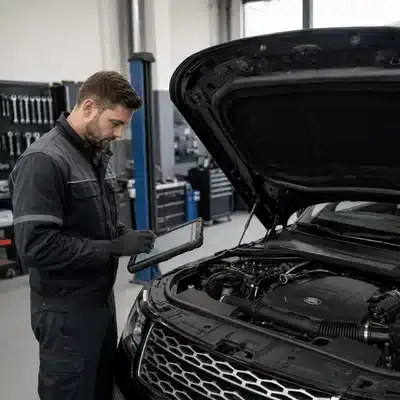
Generic code reading is not enough for modern Land Rover vehicles. These vehicles use complex engine management, emissions, turbo, cooling, and software systems. A proper inspection should look at the full picture before any parts are replaced.
A complete diagnostic may include:
This process helps separate a real engine fault from a sensor issue, software concern, or secondary symptom.
If the light is solid amber and the vehicle feels normal, you may be able to drive carefully to a Land Rover engine repair shop. If the light is flashing, the engine is shaking, or power is reduced, stop driving as soon as it is safe.
It usually means the vehicle has detected a fault and reduced power to help protect the engine or related systems. The cause may be a turbo, sensor, fuel, emissions, or engine management issue, so proper diagnostics are needed.
Tow the vehicle if there is a red temperature warning, low oil pressure warning, visible smoke, loud knocking, sudden power loss, or major fluid leak. Driving through these symptoms can lead to serious engine damage.
Yes, they can. JLR has noted that high levels of urban use can cause oil quality to degrade faster on certain 2.0L Ingenium petrol engines. This makes regular oil service and prompt diagnostics important for city drivers.
Use the NHTSA recall lookup tool or Land Rover’s official recall page and enter your VIN. Recall coverage depends on the exact vehicle, model year, and build details.
If your Land Rover is overheating, leaking oil, losing power, smoking, or showing an engine warning light, do not wait until the damage spreads. Europe Services Auto provides Land Rover repair in San Antonio that drivers can rely on, with careful diagnostics for engine, cooling, oil, turbo, and performance issues.
Schedule your Land Rover inspection today and get clear answers before a warning light turns into a major Land Rover auto repair.